Note
Three kinds of central
When you build software, “central versus peripheral” and “protection” sounds a bit like one idea. In practice the former does three different jobs, and “protection” quietly does two of its own. They agree often enough to look like one idea and disagree exactly where it matters. This post separates them, and shows what a simple map of the data says about each.
The app in one paragraph
Landholder Connect helps teams manage their relationships with landholders. At its core are three kinds of record: properties, the stakeholders connected to them, and the engagements with the stakeholders. Around those sit documents, obligations (promises made to a landholder), actions, list items and observations. Everything below is about deciding which of those records matters most, and the discovery that “matters most” has more than one meaning.
One phrase, three questions
Each of the three axes below is a real and useful distinction. Each was arrived at separately. The cost of treating them as one shows up when a question gets answered by the wrong one, and in our case that happened twice in a single afternoon, on a single issue.
Axis 1: the user’s path
Does somebody’s work stop without this?
Start at properties and stakeholders, work backwards to how information arrives and forwards to what is done with it. That path is central. It decides how fast a defect gets fixed.
Axis 2: what holds the app up
Does everything else flow from this?
Properties, stakeholders and engagements. It decides how hard a record is protected from destruction, and it turns out to be measurable rather than a matter of opinion.
Axis 3: what breaks quietly
If this loses its subject, would anyone notice?
A record that points outward and has nothing pointing back at it can be orphaned without any screen going wrong. It decides where silent damage accumulates, and nobody stated it, because the map found it rather than a person.
Two of the three are one chart
We counted, for every record type, how many other record types point at it and how many it points out at. Those two numbers answer axis 2 and axis 3 independently, and the picture separates cleanly into corners.
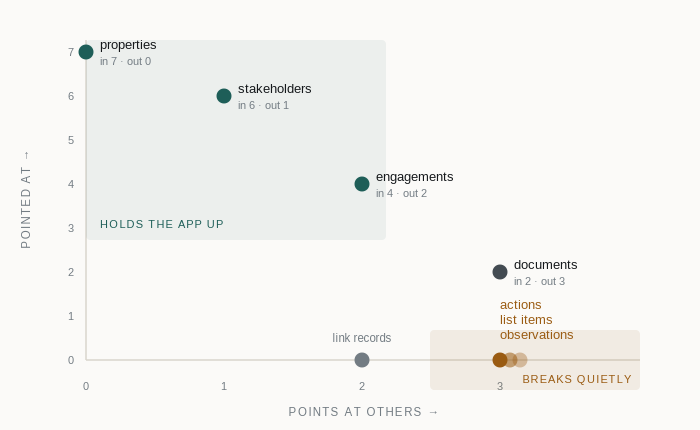
Measured against the live database, not the design on paper. The three in the lower-right corner, where nothing points at them and they point at three things each, are the three record types where orphaned records have actually been found. Two of those were discovered by the exercise that drew this chart.
The intuition and the measurement are the same claim. “There are really only three things in the database that need heavy protection: properties, stakeholders, and engagements. Pretty much everything else flows from these.” That was said before anyone drew the chart. It is the “pointed at” column read aloud: 7, 6, 4, then a gap to documents at 2 and everything else at 0.
The second corner was nobody’s intuition. Pointed at by nothing while pointing at a lot is a shape, not a hunch, and it predicted the orphaning rather than describing it afterwards. That is the part a person could not have supplied.
Where each record lands on all three
The columns disagree, and the disagreements are the useful part. Nothing here is a contradiction. Each column answers its own question.
| Record | On the user’s path | Holds the app up | Breaks quietly |
|---|---|---|---|
| Properties | central | in 7, protect | no |
| Stakeholders | central | in 6, protect | no |
| Engagements | central | in 4, protect | no |
| Documents | central | recoverable | no; busiest links |
| Obligations | central | recoverable | no |
| Observations | central | recoverable | yes, permanently |
| Actions | central | recoverable | yes, found |
| List items | peripheral | recoverable | yes, found |
| The map view | surface only | n/a | no |
The three disagreements worth knowing
Obligations: central to a user, peripheral to protect. They are part of what the app is for, and they can be recovered from the agreement, email or engagement they came from. A bug in obligations is urgent; a deleted obligation is not a catastrophe. Both readings are correct, and they answer different questions.
Observations: permanent, and not precious. They are a tracking aid rather than a record of truth: crossing something off a list. Yet they are append-only, which looks like the treatment a system of record gets. It isn’t. The permanence is a requirement of the feature. Some obligations recur (check the fence each season, report each quarter), and showing one promise with a history of activity against it needs those entries to persist. Without that, a user is pushed to create a fresh obligation every time, and one recurring promise turns into a list of individual promises that can drift over time from the original committment.
The fragility the chart found is the price of that permanence, not a bug. Observations have nothing pointing at them and three pointers out, and being append-only means a reference that goes dangling can never be repaired. The orphan is permanent by construction. So the fix is to never create the dangling reference in the first place, which is the job of careful delete rules. It is not to relax the append-only rule, which would cost the feature the very thing it exists to show.
Documents: the busiest record, with the weakest user protection. After the core records, they carry more links than anything else: there are many ways a document can arrive, inbound email among them, and many things that look at one. Busy is not the same as precious. That spiky shape is simply what a record with many entrances and many readers looks like.
“Protection” is two things as well
The word carries its own ambiguity, and documents are where it shows. Guarding a record against the person using the app and guarding it against loss nobody chose are different questions, answered by different machinery, and they can point in opposite directions on the same record.
| The question | What answers it | |
|---|---|---|
| From the user | They meant to do this. Should the app make it harder? | A confirmation that names what will go. How strong it is depends on whether the thing can be rebuilt from a source that still exists. |
| From loss | They did not choose this: a failure, a corruption, a mistake nobody made. | Durable storage and backups. Infrastructure, not interface. |
You don’t need to worry about whether you allow someone to delete one. You DO need to worry about backups for recovery, for when a user DIDN’T delete it by choice. So the busiest record gets strong backup protection, but weak user protection.
From the build notes
Documents are the worked example, and there is no inconsistency. Weak against the user, because the file started life on the customer’s own computer and they still have it. Strong against loss, because a document going missing without anybody deleting it is a different event entirely, and that protection lives in where the file is stored, not in a dialog box.
The error this prevents: arguing from “this record is busy” or “this record is important” to “make it hard to delete.” Being heavily linked is a fact about the data, not about what a person should be allowed to do with their own file. Ask which of the two losses you’re preventing before reaching for either mechanism.
So the matrix above governs one column only. “Holds the app up” ranks protection from the user. Backups are a separate judgement, mostly already answered by where the data lives rather than by anything on screen.
Which one moves, and what to do when they disagree
The only thing that’s moving seems to be my commitment to things like the permanence of obligations.
From the build notes
That turns out to be the most useful thing to know about the three axes. They change at very different speeds, and that decides which one to trust when they disagree.
- Slowest: what breaks quietly. Changes only when the database structure does. What points at what is a fact about the data, and it barely moves from week to week.
- Slow: what holds the app up. Follows the structure. Properties, stakeholders and engagements have been the core since the product had a shape, and nothing proposed since would change the ranking.
- Fastest: the user’s path. Moves with the product. A feature can arrive, be promoted onto the main path, or be retired off it, and each time the priority of everything near it changes.
So when an opinion and the structure disagree, check which one moved. A shifting view of what obligations are for is a product judgement being sharpened, and it is allowed to move. A shifting view of what points at what would be a change to the database, and somebody should be able to name it.
Which axis answers which question
| The question in front of you | The axis that answers it |
|---|---|
| How fast does this bug need fixing? | the user’s path |
| Should this delete be refused, or just confirmed? | holds the app up |
| Should this button warn before it destroys something? | holds the app up |
| Where should a safeguard go? | breaks quietly |
| What might already be broken that nobody has reported? | breaks quietly |
| Is this worth building at all? | none of them: that’s a product question |
The failure mode is real, and we have a worked example. One analysis reasoned from a rule about records created inside the app and concluded that a deleted obligation was a worse loss than a deleted title plan. The reasoning was careful, the rule was quoted accurately, and the answer was backwards, because a protection question had been settled with a priority rule. No written rule would have caught it; a person did. It is the experience of this kind of analysis that lets you know that you need to look out for these things.
And the rules should stay stricter than this framework. Where our own rules overstate what a minor record is owed, that is deliberate: a rule that is too strong costs a conversation, and a rule that is too weak costs data. Handle the exception where it comes up, and let the rule keep its strong wording.